
Raw silk refers to silk fibres that have been reeled directly from silkworm cocoons without full degumming. This process retains the natural sericin and gives the silk a slightly coarse texture. In contrast, шёлковая пряжа is a processed, spun, and often degummed form of silk that is used for weaving and knitting applications. According to the International Sericultural Commission (ISC) and textile engineering references such as the ‘Handbook of Textile Fibres’ (J. Gordon Cook), raw silk is an intermediate material in silk production, whereas silk yarn is a refined, engineered product used in most textile manufacturing processes.
Put simply, raw silk is closer to its natural state, while silk yarn is an optimised industrial product designed for strength, consistency, and efficient fabric production.
Введение
Silk is one of the most valuable natural fibres in human history. It has played a key role in global trade, luxury fashion, and textile engineering. From the ancient Silk Road to modern high-performance fabrics, it continues to represent a unique combination of natural beauty, mechanical strength, and microscopic structural complexity.
However, terms such as ‘raw silk’ and ‘silk yarn’ are often misunderstood or used interchangeably within the silk processing chain, even though they represent distinctly different stages of fibre transformation. This distinction is not merely semantic; it directly affects weaving performance, fabric texture, dye absorption, durability, and cost structure.
In industrial textile production, it is essential for manufacturers, designers, and procurement specialists to understand the difference between raw silk and silk yarn in order to optimise fabric quality, production efficiency, and end-product performance.
What Is Raw Silk?
Raw silk is the natural filament obtained from silkworm cocoons (mainly Bombyx mori) after reeling, but before complete chemical or mechanical refinement. It contains a significant amount of sericin, a gum-like protein that binds the silk filaments together within the cocoon.
This sericin coating gives raw silk a slightly stiffer and coarser texture than fully processed silk yarn. It also gives raw silk a more matte appearance and higher stiffness in its untreated state.
Key characteristics of raw silk:
- Contains a natural sericin coating
- Slightly rough texture compared to refined silk
- Higher stiffness and lower flexibility
- Natural golden or off-white colour
- Strong filament continuity
- Requires further processing before weaving
Raw silk is typically produced during the reeling stage, where multiple filaments from cocoons are combined into a continuous thread. However, as it is neither fully degummed nor spun into standardised yarn, it is considered an intermediate raw material rather than a finished textile.
What Is Silk Yarn?
Silk yarn is a processed textile fibre made from raw silk that has undergone degumming, spinning, twisting, and finishing processes. This transformation removes most of the sericin coating and aligns the fibres to create a more uniform structure that is suitable for weaving, knitting, and industrial textile production.
Unlike raw silk, silk yarn is engineered for consistency. It is graded and standardised, and is often blended or treated to achieve specific performance characteristics, such as elasticity, lustre, or tensile strength.
Key characteristics of silk yarn:
- Fully or partially degummed
- Soft and smooth texture
- High flexibility and elasticity
- Uniform diameter and strength
- Enhanced dye absorption
- Suitable for industrial weaving and knitting
Silk yarn is the primary material used to produce fabrics such as silk satin, silk chiffon, and silk crepe, as well as other luxury textiles.
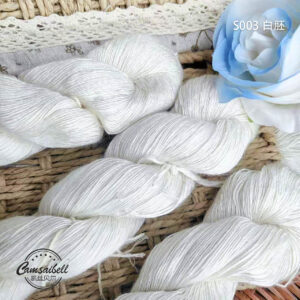
From Cocoon to Yarn: The Transformation Process
The process of turning raw silk into silk yarn involves multiple controlled stages, each of which influences the material’s final properties.
Reeling
Silk filaments are carefully unwound from boiled cocoons and combined into continuous strands.
Degumming
Sericin is partially or fully removed using hot water or enzymatic treatment to improve softness and flexibility.
Spinning
fibres are aligned and twisted into uniform yarn structures to improve strength and consistency.
Twisting and winding
Yarns are twisted to achieve the desired thickness and mechanical stability, and then wound onto spools.
Finishing
Additional treatments may be applied to enhance lustre, dye affinity, or tensile strength, depending on the intended use.
It is this controlled transformation that differentiates industrial silk yarn from raw silk in terms of both performance and usability.
Raw Silk vs Silk Yarn Comparison
| Характеристика | Raw Silk | Шелковая пряжа |
| Processing Level | Minimal processing | Fully processed and refined |
| Sericin Content | Высокий | Low or removed |
| Текстура | Coarse, stiff | Soft, smooth |
| Usage Stage | Intermediate material | Final textile input |
| Uniformity | Low consistency | High consistency |
| Dye Absorption | Limited | Превосходно |
| Industrial Use | Limited weaving preparation | Widely used in fabric production |
This comparison highlights that raw silk is primarily a transitional material, while silk yarn is a standardized industrial product designed for large-scale textile manufacturing.
Structural Differences at Fiber Level
At a microscopic level, raw silk has a multi-filament structure that is bound by sericin. This increases the material’s rigidity and reduces the mobility of its fibres. While this structure provides strength, it limits flexibility.
Silk yarn, on the other hand, has undergone a controlled process of mechanical and chemical treatment that removes excess sericin and aligns the fibroin molecules. The result is improved elasticity, a smoother surface morphology, and better interaction with dyes and finishing chemicals.
These structural differences significantly affect how each material behaves during weaving, knitting, and finishing processes.
Industrial Role in Textile Manufacturing
In modern textile engineering, raw silk is rarely used directly in fabric production. Instead, it is pre-processed in specialised silk processing facilities.
Silk yarn is the dominant material used in:
- Luxury fashion fabrics
- High-end apparel production
- Interior textiles
- Technical silk blends
- Industrial weaving systems
Because of its uniformity, silk yarn ensures stable loom performance, reduced breakage rates, and predictable fabric quality — critical factors in mass production environments.
Some supply chains include specialised manufacturers such as Loyal Yarns, which provide customised silk yarn solutions for weaving mills. These solutions offer variations in twist level, thickness, and finishing to match specific textile requirements.
Application-Based Silk Material Selection
| Application Area | Preferred Material | Reason |
| Silk weaving mills | Silk yarn | High uniformity and stability |
| Experimental textile production | Raw silk | Natural fiber testing and research |
| Luxury fashion fabrics | Silk yarn | Soft texture and dye performance |
| Traditional handicrafts | Raw silk | Natural aesthetic and texture |
| Industrial textile manufacturing | Silk yarn | Machine compatibility |
Performance Differences in Textile Manufacturing
In real textile production environments, the difference between raw silk and silk yarn is much more pronounced than in theoretical classification. Raw silk behaves more like a semi-processed natural filament bundle, whereas silk yarn is a fully engineered textile input designed to deliver consistent fabric output and predictable machine performance.
During weaving, the presence of residual sericin on the fibre surface causes raw silk to exhibit higher friction variability. This can result in uneven tension control, increased thread breakage, and reduced loom efficiency. Consequently, raw silk is rarely used in high-speed industrial weaving systems without prior processing.
Silk yarn, by contrast, is optimised for mechanical stability. Its degummed and twisted structure enables it to pass smoothly through high-speed looms, reducing friction fluctuations and improving production continuity. This makes it the preferred material in modern textile mills, where efficiency, uniformity, and scalability are essential.
Another important performance factor is dye absorption. Raw silk absorbs dyes unevenly because sericin partially blocks fibre penetration. However, silk yarn, with its cleaner fibroin structure, allows for deeper and more uniform dye uptake, resulting in more consistent colouring across finished fabrics.
Quality Grading and Classification Systems
The global silk industry uses multiple grading systems to classify raw silk and silk yarn, based on the quality, uniformity, and defect rate of the filaments.
Raw silk is typically graded according to the following criteria:
- Filament continuity;
- Cocoon quality;
- Sericin content level;
- Colour uniformity;
- Reel consistency.
Higher-grade raw silk is smoother and contains fewer irregularities, but still requires further processing before it can be used in textiles.
Silk yarn grading is more standardised and includes parameters such as:
- Yarn count (denier or tex);
- Twist per metre (TPM);
- Tensile strength;
- Elongation rate;
- Hairiness and surface smoothness.
These measurable indicators make silk yarn more suitable for industrial procurement and automated textile production systems.
Cost Structure and Industrial Efficiency
From a production economics perspective, raw silk seems cheaper at the beginning of the supply chain, but additional processing steps are required before it can be used in fabric manufacturing. The additional stages of degumming, spinning, twisting, and finishing add cost, time, and energy consumption.
Although silk yarn is more expensive per unit, it offers higher overall efficiency in textile manufacturing. Its standardised properties reduce machine downtime, minimise defect rates, and improve output consistency. In large-scale production environments, this often results in a lower total cost of ownership than using raw silk directly.
The trade-off between the initial cost of the material and the efficiency of downstream processing is a key consideration for textile manufacturers when choosing between raw silk and silk yarn.
Sustainability and Modern Textile Trends
Sustainability has become a key focus for the global silk industry. Traditional processing methods require a lot of water and involve chemical treatments, particularly during the degumming stage.
Modern innovations aim to reduce environmental impact by:
- Enzymatic degumming processes (using fewer chemicals);
- Closed-loop water recycling systems;
- Low-energy spinning technologies;
- Waste fibre recovery systems.
Silk yarn production benefits more directly from these advancements because it integrates more efficiently with controlled industrial systems. Raw silk processing is less standardised and often requires more variable handling, which can increase resource consumption.
Additionally, there is a growing interest in traceable silk supply chains where fibre origin, processing conditions, and environmental impact are digitally tracked to ensure ethical sourcing and compliance with sustainability standards.
Industrial Applications Overview
Raw silk and silk yarn have different functions within the textile production process.
Raw silk is primarily used for:
- Traditional silk processing workshops
- Research and material testing
- Specialty handloom production
- Educational textile demonstrations
Silk yarn dominates industrial applications such as:
- High-speed weaving mills
- Fashion textile manufacturing
- Luxury apparel production
- Interior fabric production (e.g., curtains and upholstery)
- Blended fabric engineering (e.g., silk-cotton and silk-wool blends)
Because of its stability and consistency, silk yarn is essential for automated textile systems where precision and repeatability are critical.
Industrial Application and Performance Comparison
| Фактор | Raw Silk | Шелковая пряжа |
| Machine Compatibility | Низкий | Высокий |
| Production Efficiency | Средний | Высокий |
| Fabric Consistency | Variable | Stable |
| Dye Uniformity | Низкий | Высокий |
| Scalability | Limited | Industrial-scale ready |
| Automation Suitability | Низкий | Высокий |
This comparison clearly shows that silk yarn is optimized for industrial scalability, while raw silk remains more relevant in traditional or specialized contexts.
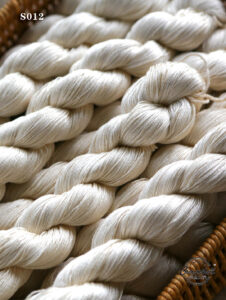
Future Trends in Silk Processing Technology
The silk industry is undergoing a transformation, driven by automation, innovations in material science, and the need for sustainability.
One emerging trend is precision-controlled silk degumming, which uses enzymatic or low-temperature processes to preserve fibre integrity while minimising environmental impact. This improves the quality of silk yarn while minimising resource consumption.
Another trend is the integration of digital textile manufacturing systems that monitor silk yarn properties such as tension, twist, and elasticity in real time during production. This ensures consistent fabric output and reduces material waste.
Additionally, demand for hybrid silk materials is increasing. Silk is now often blended with synthetic or recycled fibres to enhance durability, lower costs, and expand its use in technical textiles and performance apparel.
Frequently Asked Questions (FAQ)
- What is raw silk used for?
Raw silk is mainly used as an intermediate material in silk processing, traditional weaving, and textile research rather than direct industrial fabric production.
- What is silk yarn made from?
Silk yarn is produced from raw silk after degumming, spinning, and twisting processes that refine and standardize the fiber.
- Is silk yarn stronger than raw silk?
Yes. Silk yarn generally has higher uniform strength due to controlled processing and uniform fiber alignment.
- Why is raw silk rougher than silk yarn?
Raw silk contains sericin, a natural gum that increases stiffness and surface roughness compared to refined silk yarn.
- Which is better for textile manufacturing?
Silk yarn is better suited for industrial textile manufacturing due to its consistency, machinability, and dye performance.
- Can raw silk be directly woven into fabric?
It is possible in traditional or specialty weaving, but it is not commonly used in industrial-scale production without processing into yarn.
Заключение
The difference between raw silk and silk yarn lies in their level of processing, structural uniformity, and industrial usability. Raw silk is a natural filament material that has undergone minimal processing and retains sericin, reflecting the fibre’s original biological state. Silk yarn, on the other hand, is a fully engineered textile product designed for stability, consistency, and large-scale manufacturing efficiency.
In terms of production, silk yarn dominates the modern textile industry due to its compatibility with high-speed weaving systems, superior dye absorption, and consistent performance. While raw silk remains important as an upstream material and in specialised or traditional applications, it is rarely used directly in industrial fabric production.
Understanding this distinction is essential for textile engineers, procurement specialists, and manufacturers seeking to optimise production efficiency, fabric quality, and supply chain performance.

 Russian
  English
  Japanese
  Korean
  Spanish
  French
  German